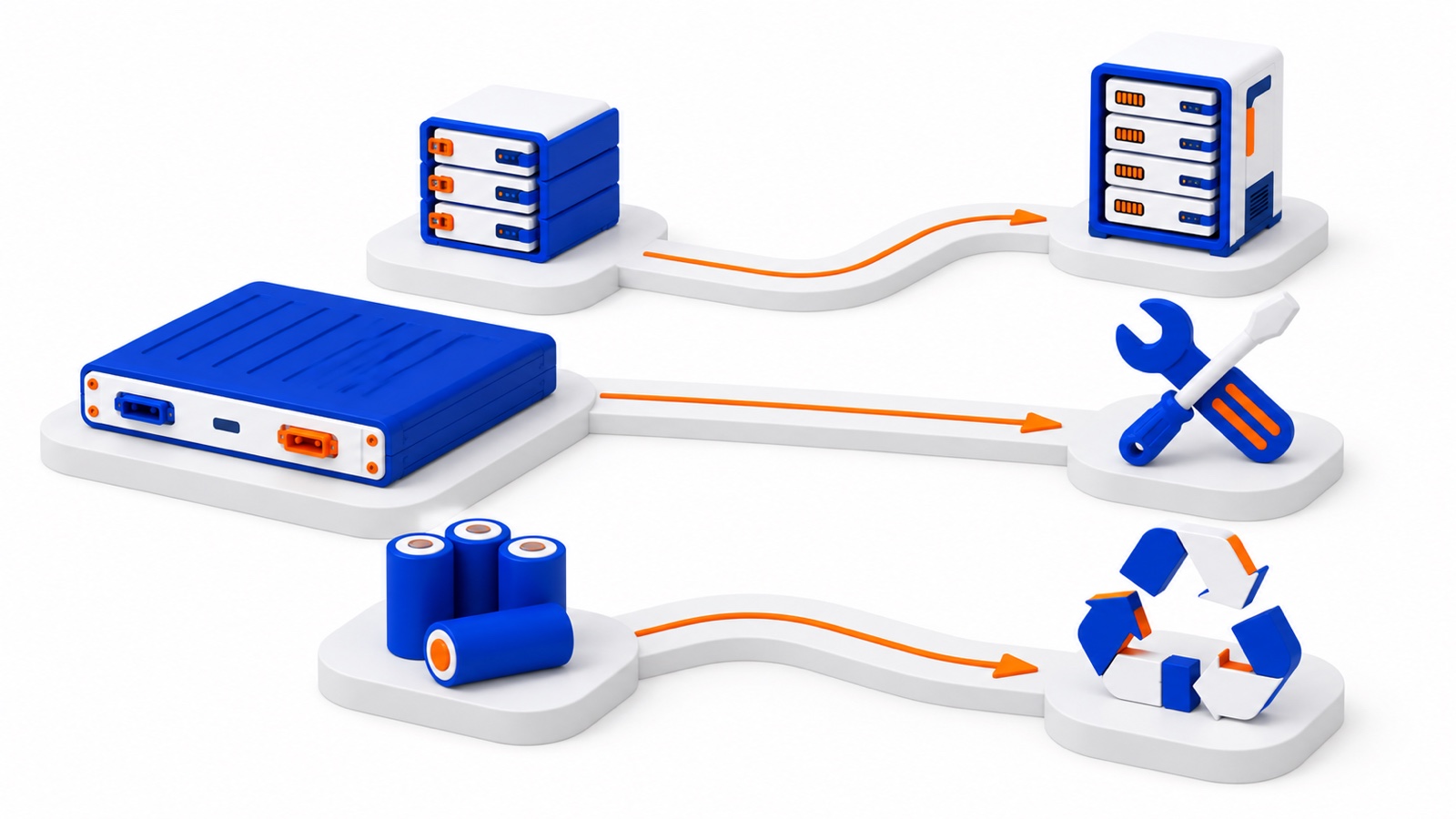
Battery chemistry changes the economics of reuse and recycling. It does not decide the route on its own.
An LFP pack, an NMC pack and an NCA pack can contain different material value, offer different performance characteristics and suit different applications. Their actual next step still depends on condition, architecture, evidence, integration effort and real demand.
Why chemistry matters
Lithium-ion batteries are commonly grouped by cathode chemistry. Lithium iron phosphate, or LFP, contains no nickel or cobalt. NMC and NCA chemistries contain varying amounts of higher-value metals and have historically offered higher energy density.
These differences affect both applications and recovery economics. The International Energy Agency notes that NMC is particularly suited to recycling from a material-value perspective, while the lower residual material value of LFP can put pressure on recycling business models. That does not make LFP unsuitable for recycling. It means the commercial model may need a paid treatment service or another agreed structure.
LFP can suit stationary use, but the case still needs proof
LFP is widely used in stationary storage because of its cost, cycle-life characteristics and safety profile. A used automotive LFP pack may therefore appear to be a natural second-life candidate.
The route is only credible when the pack is safe, its remaining performance is measured, its interfaces can be managed, and the cost of integration competes with new batteries. Falling prices for new LFP systems raise the evidence threshold for used packs. Remaining capacity alone does not prove a viable project.
NMC and NCA create a different trade-off
Nickel-based chemistries can carry stronger material recovery value. They may also remain useful for repair or second-life applications when condition and demand support that route. Sending every NMC or NCA pack directly to recycling can discard functional value. Sending every pack toward reuse can ignore safety, degradation and integration cost.
The decision should compare the achievable value of a qualified reuse route with the complete cost and risk of reaching it. If the evidence is weak or the integration burden is too high, recycling may be the better outcome even when capacity remains.
Pack architecture can matter as much as chemistry
Two packs with the same chemistry may require very different work. Module-based designs can allow selective repair or component recovery. Cell-to-pack and structural designs can reduce access and make disassembly more difficult. Cooling, connectors, communication, enclosure condition and available technical documentation all affect the feasible route.
This is why BatteryCentr assesses packs, modules and cells against a specific application. A generic chemistry label is a filter. It is not a grade, safety decision or purchase specification.
A practical routing sequence
- Confirm identity, chemistry, format, origin and available records.
- Screen condition and safety before transport or electrical testing.
- Measure the performance needed for the possible onward route.
- Compare technical fit with demand, integration cost and logistics.
- Route to reuse, repair, component recovery or certified recycling.
This sequence avoids a one-size-fits-all answer. It also creates the structured evidence buyers need. Read more about our battery matching programme and testing and grading process.
Chemistry shapes the route. Evidence decides it.
Useful shorthand can help teams sort an incoming battery flow, but no chemistry deserves an automatic outcome. The strongest decision joins material value, functional value, safety and execution economics for the exact asset in front of you.
If you hold mixed battery types, share the batch details. BatteryCentr can scope assessment and routing as a service, or discuss acquiring suitable batteries under agreed terms.