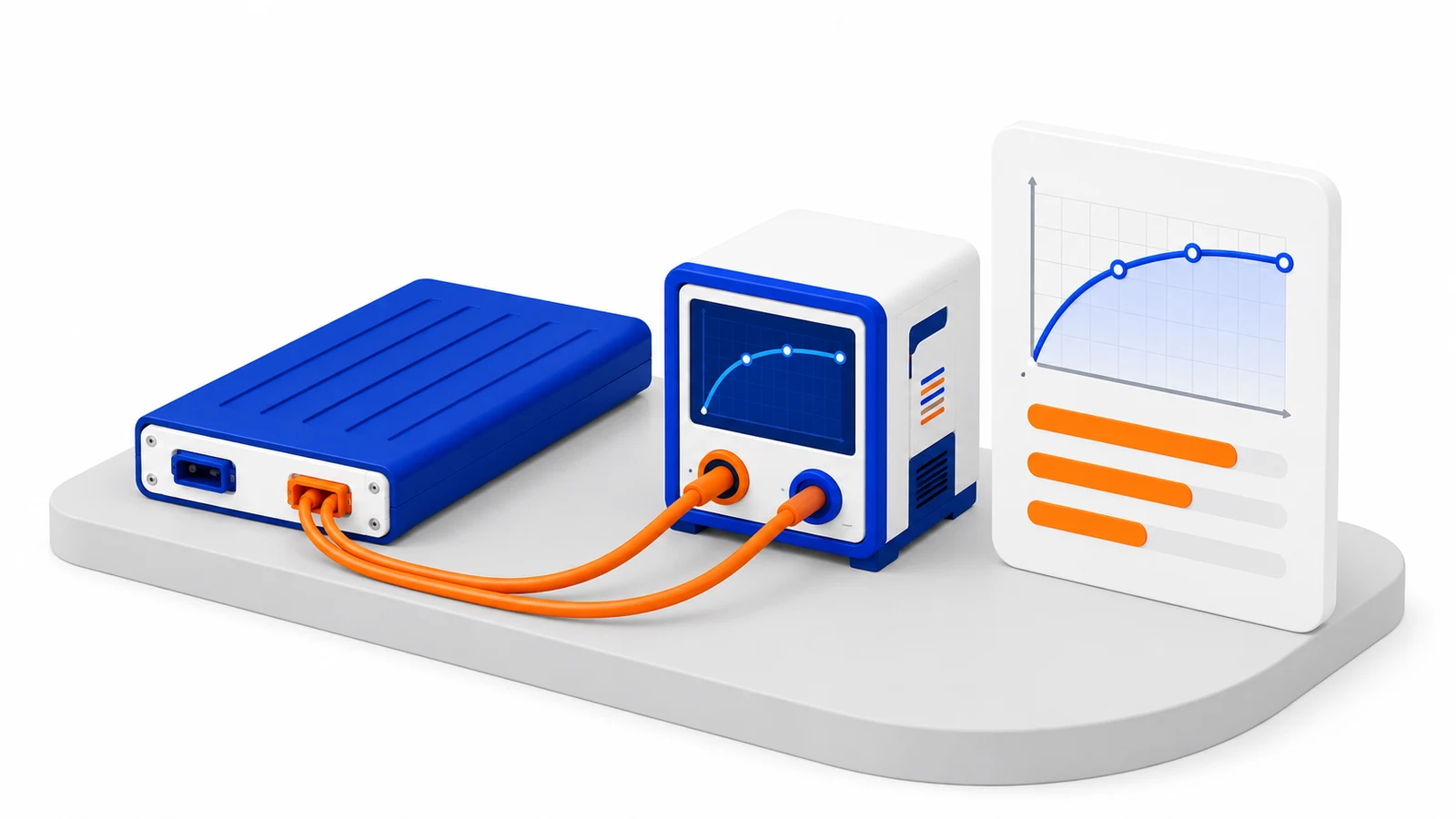
Two identical-looking EV battery modules sit on a pallet. One has 92% of its original capacity left; the other has 68% and an internal fault developing. Without testing, they look the same, weigh the same and — to a cautious buyer — are worth the same: very little. The number that separates them is State of Health, and the document that makes that number tradeable is the SoH report.
What State of Health actually measures
State of Health (SoH) expresses how much of a battery's original capability remains, usually as a percentage of its rated capacity. A pack rated at 60 kWh that can still store 48 kWh has an SoH of 80%. But capacity is only the headline. A meaningful assessment also looks at:
- Internal resistance — how much the battery has aged electrically, which affects power delivery and heat.
- Cell balance — whether cells inside a module have drifted apart, an early warning of weak cells dragging the pack down.
- Safety condition — mechanical damage, swelling, thermal history and fault codes that decide whether the battery should be reused at all.
A battery retired from an EV may still retain useful capacity, but the remaining performance cannot be assumed from age or appearance. A defined test method is needed before another application can rely on it.
Why buyers won't move without a report
Serious buyers of second-life components — storage-system builders, integrators, repairers — engineer their products around known inputs. A module with a documented 85% SoH and matched internal resistance can be designed into a system. A module with unknown history is a project risk, and buyers price risk brutally: unknown packs trade near scrap value, if they trade at all.
A useful SoH report reduces uncertainty. It states what was measured, how and when, so a buyer can judge whether the evidence fits the intended application. Evidence supplied through our battery matching programme is defined for each opportunity and may include a scoped test record.
What a proper SoH report contains
At minimum, expect the following in a report worth the name:
- Battery identity: chemistry, original rating, format and source type
- Measured usable capacity and the resulting SoH percentage
- Internal-resistance results against expected values
- Safety screening outcome, including visual and thermal checks
- An assigned grade or tier, with the criteria behind it
- Test method and date, so results can be trusted — and re-verified
The grading tiers matter as much as the raw numbers. Sorting components into consistent tiers is what lets a buyer order "ten Grade-A modules" instead of negotiating every unit individually. Cell-level test methods such as IEC 62660 underpin how the measurements are made; our pack check explains how we apply them in practice.
The regulatory tailwind: health data becomes mandatory
The EU Battery Regulation (2023/1542) introduces a Battery Passport for EV and larger industrial batteries, carrying data about a battery's condition through its life. The direction of travel is clear: documented battery health is moving from competitive advantage to market requirement. Batteries that enter the second-life chain with clean, structured health data will be the easy ones to sell — and the ones without it will keep losing value to uncertainty. (More on the regulation in our guide to 2023/1542.)
What this means if you hold used batteries
If you're sitting on used packs as a scrapyard, dismantler, fleet or insurer the practical takeaway is that incomplete evidence adds uncertainty. Testing can make capacity, condition and safety observations visible to a potential onward user. BatteryCentr checks and grades packs per step, while you keep ownership of them.
Have batteries you'd like assessed? Tell us what you're holding and choose the arrangement you prefer.