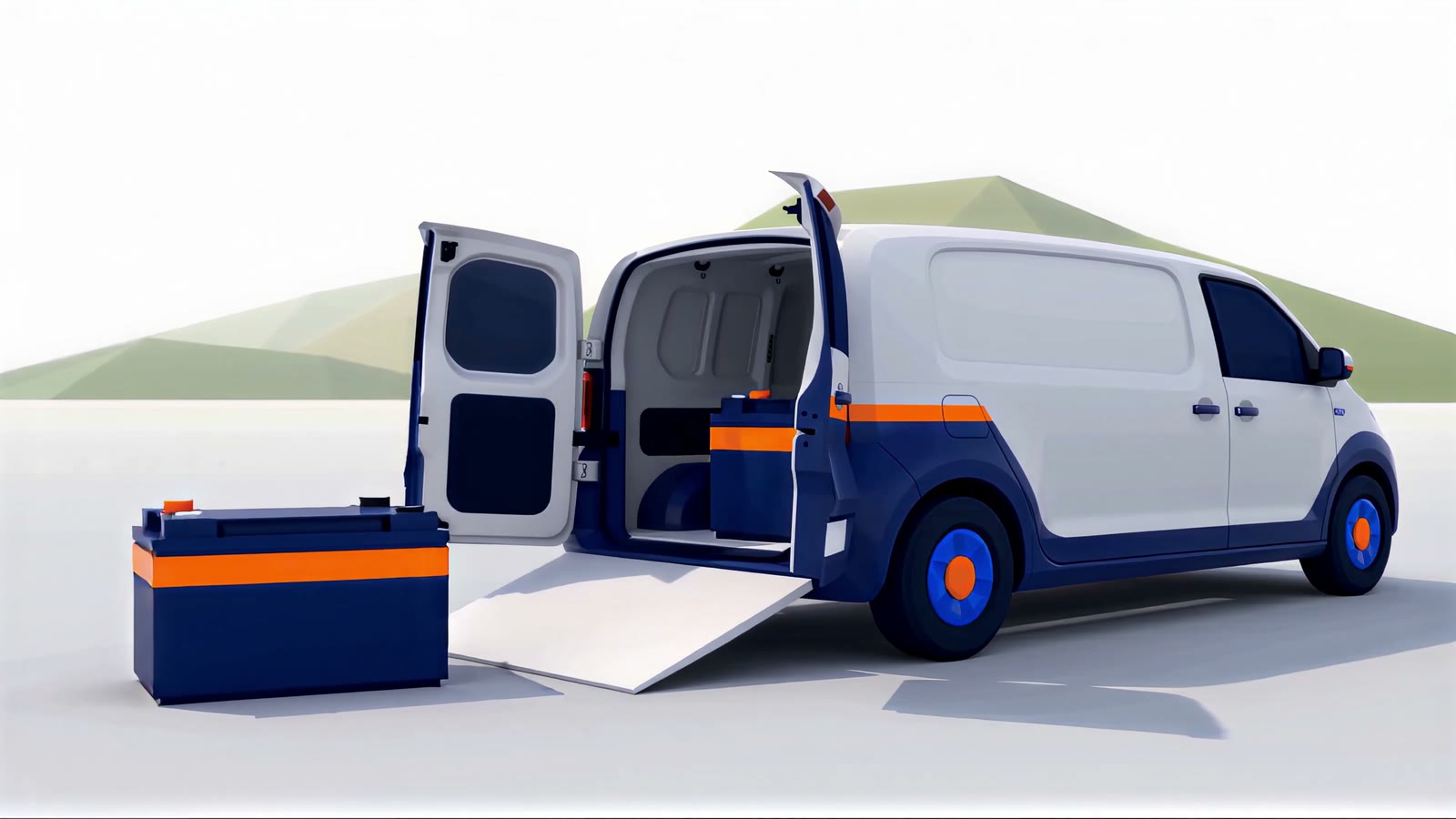
Almost every conversation we have starts in the same place: a corner of a workshop, a pallet in a yard, a caged-off section of a warehouse. Retired EV packs, e-bike and e-scooter batteries, industrial modules — bulky, heavy, hazard-classed, and occupying floor space that was meant for something that earns money. Most of the companies holding them see only the burden. What they rarely see is that a pack retired from a vehicle usually still holds 70–80% of its original capacity: not enough for a car promising full range, but years of useful service somewhere else.
The gap between "problem" and "asset" is a process — collection, compliant transport, testing, and a decision about where each battery goes next. The video below shows how it works; the rest of the article walks through each step.
Step 1 — Collection: we pick the batteries up
Used battery collection starts with a description, not a quote. Tell us what you're holding — chemistry and type if you know it, rough weight or unit count, whether anything is damaged — and we plan a pickup around it. Our battery collection service covers EV packs, e-mobility batteries and industrial units across Europe, from a single damaged pack to recurring fleet volumes.
We handle the parts that make EV battery pickup awkward for everyone else: classification, packaging requirements, the paperwork that has to travel with the load, and the loading equipment for units that can pass half a tonne. You confirm what's on site; we arrive with the right vehicle and the right documents. If you want to start there, tell us what you're holding and we'll come back with a collection plan and an indication of value.
Step 2 — Compliant transport and safe storage
Lithium-ion batteries are dangerous goods — UN 3480 and UN 3481 under ADR, the European agreement on the road transport of hazardous materials. That means trained drivers, correct classification and labelling, approved packaging, and transport documents that survive a roadside inspection. Damaged or defective packs are stricter again (special provision 376) and need dedicated packaging and routing. Our battery logistics operation is built around those rules rather than working past them.
Cells also sit downstream of UN 38.3 transport testing, which every lithium cell and battery design must pass before it moves commercially. On arrival, batteries go into compliant battery storage — segregated, state-of-charge managed, fire-detected, and recorded so every unit has a chain of custody from your site onward. That record is what a buyer, auditor or insurer asks for later.
Step 3 — Testing and grading: making value visible
Two identical-looking modules can be worth wildly different amounts, and nobody can tell which is which by looking. So every battery we take in is measured. Our testing & grading process establishes usable capacity and the resulting State of Health, internal resistance against expected values, cell balance within a module, and a safety screen covering mechanical damage, swelling and thermal history.
The output is a documented grade, not an opinion. It turns a pallet of unknown packs into something a storage-system builder can design around — and it is the single biggest lever on price, because untested batteries trade at pessimism prices. What a proper report contains is in our guide to State-of-Health reports.
Step 4 — The maximum-value decision: second-life or recycling
Grading decides the route. Batteries and modules with healthy capacity and a clean safety record go to second life: repurposed into stationary storage, sold as tested packs, modules or cell batches, or supplied to repairers who need matched components. Those are the units listed in our products programme, each shipped with its test data.
Batteries that fail the safety screen, or that have degraded past useful reuse, go to certified recycling, where lithium, cobalt, nickel and copper are recovered into the supply chain instead of being lost. Both routes are legitimate outcomes; the point is that the choice is made on evidence rather than convenience. For a fuller comparison of the options, see what to do with used EV batteries.
Why this matters now
The EU Battery Regulation (2023/1542) applies directly in every member state and covers the whole lifecycle, not just manufacture. Waste batteries have a mandatory destination, recyclers face rising recovery targets, and from 2027 EV and larger industrial batteries carry a digital Battery Passport holding composition, capacity and State-of-Health data.
The practical consequence for holders is that informal disposal routes are closing while documentation becomes the price of entry. A pallet with no paper trail gets harder to sell, move or even dispose of each year. Our read of what it means for holders is in our guide to 2023/1542.
Who we work with
The batteries reaching us come from a narrow set of places: fleets and leasing operators retiring EVs, dismantlers and scrapyards processing end-of-life vehicles, workshops left with replaced packs, e-mobility operators cycling through e-bike batteries, and insurers dealing with written-off vehicles. Volumes range from one pack to regular multi-pallet collections; both are normal.
What each wants is the same: the batteries gone, legally, with a record of where they went and a fair return on what they were worth. Our sell your batteries pages set out how that works per battery type, including EV batteries, e-bike and e-scooter batteries and industrial battery packs.
Got batteries taking up space? Tell us what you're holding — we'll arrange the collection and take it from there.